
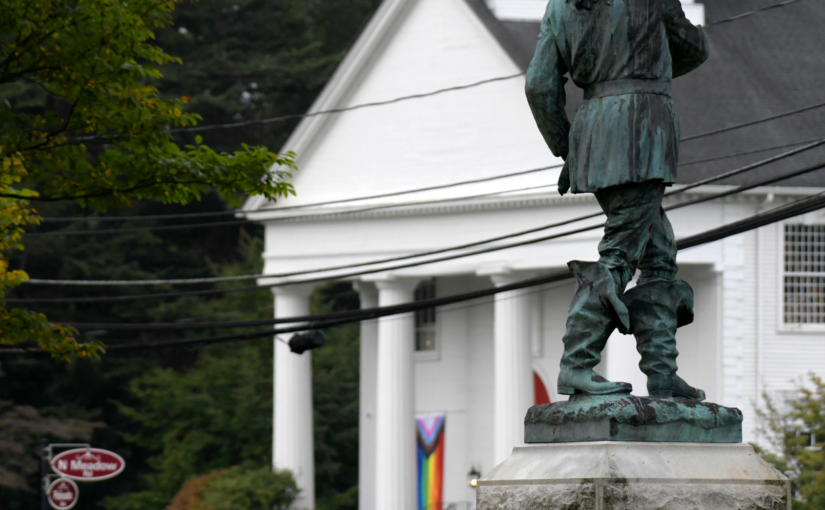
This piece appeared in the Windsor Journal on October 10, 2026.Over the course of several days in September, someone tore down a pride flag from First Church, stole a memorial bench from AME Zion Church dedicated to a couple who led the Freedom Trail Committee for 25 years, and stole a Freedom Trail plaque from the U.S. Colored Regiments Memorial Monument at Windsor Veterans Memorial Cemetery. The vandalism occurred during Connecticut Freedom Trail Month, designated to celebrate the Freedom Trail Committee’s 30th anniversary.
Elected officials responded to these acts with remarks consistent with the community’s disgust and outrage. Mayor Black-Burke, Lt. Gov. Bysiewicz, Rep. Garibay, and Rep. Khan all commented on Windsor’s laudable diversity and expressed the sentiment that hate and discrimination are not welcome here.
Windsor, and Connecticut more broadly, has a proud history of pluralism and bravery in the face of bigotry. Of the roughly 2,200 Black Connecticut residents eligible for military service in the 1860 census, three quarters enlisted and roughly 15% gave their “last full measure of devotion” in the War of the Rebellion. Windsor residents still alive today tell of the remarkable diversity of Windsor’s tobacco workforce at a time when other parts of the country enforced a legal race-based caste system. More recently, Connecticut was one of the first states to legalize same-sex marriage.
We can and should be proud of this history, but we must also be clear-eyed about our shortcomings, both historical and present. Connecticut remains one of the most housing-segregated states in the country. Closer to home, the recent vandalism follows a spate of racist and homophobic vandalism in Poquonock in 2012, and nooses placed at the Amazon warehouse several years ago. Further back, Connecticut enforced one of the country’s most draconian bans on contraception until 1965. People were enslaved right here in Windsor.
Windsor residents also participated in the wars that kicked off the centuries-long genocide of Native Americans. Only sixteen years after the comity celebrated in the first Thanksgiving, resident John Mason commanded the colonial militia that set fire to Mistick Fort and killed any Pequots attempting escape. He massacred 400-700 men, women, and children, despite his Narragansett allies’ strenuous objection to the wanton murder of their traditional enemies. Windsor resident William Hayden also participated in the massacre. Mason later justified his actions: “Thus did the Lord judge among the Heathen, filling the Place with dead Bodies.”
John Mason’s statue still stands on Palisado Green, drawing his sword in view of the pride flag that replaced the one recently stolen from First Church. Apologists for this and similar statues often claim the necessity of such monuments to mistakes of the past, while also asserting that historical figures are beyond the judgment of modern social mores. John Mason’s actions drew condemnation in his own lifetime; he represents precisely the kind of bigotry and religious zealotry that the founding generation rejected when they proclaimed “all men are created equal,” when they codified the separation of church and state, and when they tore down every statue of George III they could find.
It’s easy to say hatred has no home here, but the reality is that one of our town greens hosts a monument to religiously and ethnically motivated violence. Bigotry has always been here, and must be resisted through the constantly renewed practice of democracy, compassion, and pluralism. We can’t convince every racist and homophobe of the irrationality, insecurity, and stupidity of their beliefs, but we can start by making our public places reflective of the parts of our heritage we can be proud of.