The Debt Ceiling is Unconstitutional

I’d like to put forward a proposal to stop the recurring manufactured crisis that is the debt ceiling.

Stop pretending it’s legal.

In this era of increased partisanship and stochastic violence, there’s also the pervading sense that our legal institutions are straining under their own weight. If we’re looking for root causes, we should consider the many extra-constitutional features of the nation’s political institutions as currently constituted. For starters, political parties as a legal unit of governance. The framers did not predict the emergence of parties and a few warned us directly of their malevolent influence on the republic once they emerged. George Washington famously called them, “potent engines, by which cunning, ambitious, and unprincipled men will be enabled to subvert the power of the people.” Add to this state-wide apportionment of electors in presidential elections, the filibuster, constraining the house membership to an arbitrary number set a hundred years ago, and you start to get a picture of the elements of our current political system that are not in the Constitution and, in fact, are often used to subvert the Constitution’s underlying principles of popular sovereignty and majority rule.

But even these ailments, bad as they may be, are not unconstitutional per se; they are omissions. They are the results of institutions and political parties taking advantage of gaps in our founding documents.

The debt ceiling, on the other hand, violates the Constitution ipso facto.

To understand why, let’s do a quick Constitutional refresher on the relevant sections: In Article I, Congress passes laws. In Article II, the president executes those laws, hence the “executive branch.” The relationship between Congress and the executive is crystal clear in the Constitution. It charges the president with the duty to “take Care that the Laws be faithfully executed.” We may live in strange times. Trump may claim the right to impound funds. Stephen Miller may claim “plenary authority” for the president. But we must remember the framers’ clear intent that the president’s duty is to execute laws passed by Congress. This includes laws concerning spending and debt.

The 14th amendment addresses the public debt directly, “The validity of the public debt of the United States, authorized by law, including debts incurred for payment of pensions and bounties for services in suppressing insurrection or rebellion, shall not be questioned.” The current Supreme Court likes to pretend the 13th, 14th, and 15th Amendments don’t exist, but they are just as binding as the bill of rights. On the question of debt the 14th Amendment provides an explicit directive: it is unconstitutional for the government to refuse to pay public debt. Supreme Court case Perry v. United States affirmed this interpretation of the public debt clause. Writing for the majority, Chief Justice Charles Hughes characterized “the expression ‘validity of the public debt’ as embracing whatever concerns the integrity of the public obligations.”

It’s worth noting that the 14th Amendment addressed the concern that former confederates reentering the federal government would refuse to pay the public debt as payback for Congress invalidating Confederate debt or to hold the budget hostage to gain political concessions (sound familiar?)

It’s worth taking a moment to consider the precise chain of legal obligations at work here. The constitution states the president must follow the laws set forth by Congress, and that neither Congress nor the president may question the validity of the public debt. Congress collects taxes and duties to fund the government. Congress passes a budget, which is just a law instructing the executive branch how to spend those funds.

We may not agree with specific policy decisions made along this chain of commitments, but this is how the system is supposed to work. Trump’s illegal acts in office notwithstanding, the president can’t refuse to spend the money specified in the budget, both because of his Constitutional obligation to “take care” that the budget he signed into law is faithfully executed, but also because the 1975 Impoundment Act specifically forbids it. He also can’t raise taxes to fund the budget; that power is granted to Congress in Article I, Section 8 of the Constitution. (The same section renders Trump tariff-by-executive-order scheme unconstitutional, but that’s a subject for another day). He can’t print more money; Congress vested that power in an independant (for now) agency. The only option is to borrow money within the statutory limits of the budget.

Enter the heel in our melodrama, “The Debt Ceiling.” Congress now passes a different law, separate from the budget. Contrary to much of the rhetoric around the issue, the debt ceiling has nothing to do with spending. It simply forbids the president from borrowing money once the debt reaches an arbitrary threshold. In effect, Congress has spent more than it collected in taxes, borrowed money to cover the difference, and then told the person responsible for writing the checks to stop paying the bills. If this sounds a lot like Congress calling the public debt into question, that’s because that’s exactly what it is.

This puts the president in an impossible position. Congress is, in effect, forcing the President to choose between two different ways to violate the Constitution 1) ignore the debt ceiling to meet the 14th Amendment obligation, thereby violating the budget law 2) accept the debt ceiling and ignore the budget, thereby violating the 14th Amendment. In both cases, Congress has directed the president to break a law, which also forces the president to violate the aforementioned “take care clause.”

In our system, we call laws directing the executive branch to violate the Constitution “Unconstitutional.”

Every president who has had to deal with this legal knot, thus far, has chosen option two in the hopes that there is enough slack in the system that they will not have to actually default on US debt. Both political parties have consented to this state of affairs because it allows them to extract policy concessions when they are in the minority by holding the government hostage. 

For Republicans, it’s a win-win. Shutdowns reify Republican’s accusation of government incompetence and chaos, so they either get what they want in the policy negotiations or they get thrown into the proverbial briar patch. The motivations for Congressional Democrats are more complicated. Shutdowns cause major policy headaches when they occupy the Whitehouse, effectively opening a whole new round of budget negotiations. More generally, shutdowns portray the government as dysfunctional (which, in this case, it most certainly is). People are more likely to blame shutdowns on the party advocating governmental competence and the status quo. 

In the face of an ever-increasingly authoritarian president, however, Democrats are reluctant to give up any levers to check the executive branch while they are in the minority. Some Democrats may be grateful for the opportunity the debt ceiling affords to stick a thumb in Trump’s eye. Fair enough. But taking a step back, it’s hard to see how assenting to the debt ceiling has been anything less than a disaster for Democrats. Further, it’s hard to see how it will work out any better for them in the future. Yes, the public may blame Republicans for shutdowns occasionally, but shutdowns generally give the public the impression of a political system lurching uncontrollably from one self-inflicted crisis to the next. This makes voters gravitate towards reform/change candidates and away from candidates advocating for basic government functions: e.g. Democrats. Meanwhile Republicans will continue to use this process to extract policy preferences outside of normal legislative and Constitutional processes. This is a fight on Republicans’ turf, and Democrats are fools to continue to fight here.

Trump’s actions during this particular shutdown illustrate the dangerous power vacuum that bad actors can exploit when Congress abandons its Constitutional role. Trump’s decision to pay military personnel with money siphoned from research and development funds may sound like a good-faith effort to support the people who protect us, but it violates a foundational principle of the Constitution. It’s the People’s money and the People choose how to spend it through their representatives. If the executive can spend money the People have not allocated, and pay for it with funds the People set aside for a different purpose, then the president is no longer “executing” the will of the People: he is executing his own will. We kinda’ fought a Revolution over this issue. We shouldn’t be so quick to abandon it.

So, what should Democrats do?

Democrats should state clearly that the debt ceiling is Unconstitutional. They should seize this superseding principle and refuse to get bogged down in the weeds of extra-legislative budget debates. Say it clearly, if any president chooses to shut down the government or honor the nation’s debts, they are violating the law and the Constitution.

Use the occasion to make a simple point on the national debt: Tax. The. Rich. Government shutdowns are unpopular. Austerity measures are unpopular. By refusing to engage in the process that creates these unpopular outcomes for voters, Democrats will leave Republicans holding the bag. They will also set themselves up for a winning platform built on the pillars of Fairness, Reform, and the Constitution.

More on this platform to come.

A Fully Matured Reactionary Movement

The roller coaster of the 2020 election count moved many in the country from a grinding descent into despair into gravity-defying elation at Joe Biden’s election to the Presidency. And, of course, a little less than half the country experienced the exact same sequence of emotions in reverse order.

Few elections have so simultaneously exposed the virtues and flaws of our peculiarly American electoral system. The election went off virtually without a hitch. Despite widespread threats of voter intimidation and veiled threats of violence, actual outbursts were localized and limited. It’s too early to say what exact effect voter intimidation had, but with turnout at the highest level in a century, the most plausible answer is that it backfired spectacularly. Election officials, with a few notable exceptions, did their work in a diligent, competent, non-partisan fashion that gave the clear impression that everything was under control. The wave of legal decisions before the election, though not always just, largely cemented the ground rules in advance of the actual event, in stark contrast to the chaos surrounding the Florida recount twenty years ago. The people voted, the votes were counted; democracy was done.

Of course, that roseate description ignores the glaring injustice, arbitrariness, and anachronism of the overarching framework under which presidential elections are conducted. The 2020 election evinced, yet again, the utter hollowness of arguments in favor of the Electoral College. It does not confer preeminence to small or rural states, but rather designates states that matter, so-called battleground states, as those with a roughly even distribution of Democrats and Republicans, and then orders that subgroup of states by population, the most important swing states being those with the most electoral votes – the literal opposite effect that Electoral College proponents espouse. Arguments that the Electoral College must exist simply because it is in the Constitution are at least being honest that there are no merit-based arguments to support it; however, they fail to explain how an institution that has never been practiced as described in the Constitution can be justified by its mere presence there. The mechanism by which Electoral College supposedly benefits Republicans’ “real America,” namely winner-take-all allocation of electors, is nowhere to be found in the Constitution, and was very much opposed by the document’s primary author.

Biden held a clear, convincing, wire-to-wire lead in total votes, the method used to determine winners in every other election in the country. The only exceptions in modern times are the Mississippi governor’s race (abolished and replaced with a state-wide popular vote this year via ballot initiative) and the Republican nomination race, which allowed Trump to be nominated with a plurality of votes in 2016. The election seemed to hang in balance for days despite a clear indication of the will of the people, by millions of votes. Whatever the benefit of the Electoral College, no one can argue with a straight face that it is worth its concomitant uncertainty and undemocratic distortions to the American political system.

Constitutional issues aside, what are we supposed to make of the election results? Donald Trump was defeated, although Republicans clearly beat expectations by (likely) retaining control of the Senate, and making gains in the house. Democrats got the turnout they were looking for, only to watch in horror on election night as it was matched by an almost equal showing by new Trump voters. The New York Times’s map of partisan directional movement looks like some multicolored, fractal mess with giant swings in both directions from unexpected and, like those in south Texas and Florida, seemingly inexplicable locations.

But the tyrant was defeated and that’s all that matters, right? Your answer to this question probably depends on how seriously you took the Trump-as-symptom argument of the past four years. Democrats’ jubilation after the presidential election call was as good an indication as any that they never really internalized this idea, but rather viewed Trump as an aberration, a cancer on the body politic that could be removed surgically and, once removed, would allow for healing.

Those of us who did take this idea seriously, however, knew the instant the AP called Florida for Trump that, while the most immediate threat to the Republic may or may not be vanquished, the underlying condition would not be cured in this election.

The term “White Nationalism” gets bandied about without much thought to its underlying meaning. The idea is rooted in the understanding of a nation as a grouping of people formed on the basis of common language, history, and/or ethnicity. More importantly, nationalism extends this idea to say that individuals’ rights are only guaranteed by the nation’s sovereignty; a multicultural society denies the nation a state, and thus threatens the nation’s citizens their fundamental rights. One need only consider conservatives’ historical ease in denying rights to those they view as enemies, or even simply outside the nation (blacks, communists, “illegals”, terrorists, etc.), to show that American conservatism has never taken seriously the idea of human or “inalienable” rights, but rather has always considered rights to be granted by the nation in control of the state. Likewise, conservatives have always assumed that they would lose their rights if the state were to fall into the hands of any other group.

Photo by Mert Kahveci on Unsplash

This idea of the nation-state as the only guarantor of rights is viewed by many conservatives as the natural order of things, and more importantly that it was made that way by some larger, benevolent force; whether that be God, “the Framers”, social Darwinism, etc. The world has a structure, and conservatives need only trust the plan: have faith.

The world, of course, is more complicated than that. It exists, as is, due to forces intentional and otherwise, compounded over generations. The goal of the Enlightenment was to improve the human condition by identifying and controlling these forces: accept and understand past wrongs, work empirically and collectively to address present problems in order to insure a better future.

Trump is, in fact, a symptom. He is a symptom of a fully realized reactionary movement which rejects Enlightenment ideas of human progress and regards criticism of the status quo as the primary threat to stability rather than the underlying systemic problems that criticism seeks to address. Like all reactionary movements, this movement has resorted to restorative authoritarianism in defense of the status quo: a savior for the white nation-state that will swoop in and silence all the chaos by disappearing critics and sending undesirables back where they belong. This world-view can only render the entire Enlightenment project’s empiricism, skepticism, and reason as threats to the established order.

It is no irony that Trump launched his political career by telling a bald-faced lie, that the then President of the United States had a sordid origin on the dark continent which, to Trump’s mind and the fevered imagination of his reactionary followers, meant the first Black President ought to simply “go back where he came from.” Barack Obama’s presidency, like all inconvenient facts, represented a deep disruption to reactionaries’ sense of equilibrium. America doesn’t have a racist past you see, it’s just minorities “playing the race card,” as if liberals magically willed racism into existence by speaking its name. Obama was a daily reminder of the fragility of the white nation-state, which explains the mouth-frothing vitriol leveled at him, despite being quite politically moderate, initially quite open to negotiation, and ethically unimpeachable.

Engaging this mindset on the facts is counter-productive, however, because stated facts are viewed as the genesis of the underlying problem. Conservatives aren’t homophobic, it’s just that the gays keep rubbing everyone’s noses in it. Climate change isn’t real, it’s just liberals looking for signal in the noise to impose their economic plan on the rest of us. Instruments of violence are the only tools to provide peace in our homes. Trump and his lackeys aren’t incompetent, their agenda isn’t illegal, it’s just a “deep-state” backed by a cabal of liberal leaders who devote their global power to abducting children, raping them and stealing their blood. It is a world-view immune to evidence, which leads ineluctably to immunity to empathy and morality.

Trump has lost the presidency, but the reactionary movement he spearheaded remains, and will remain until it is rendered insignificant through the democratic process, or it ensconces itself into minority rule. What began in 2010 with the birther/Tea Party electoral reaction to Barack Obama will continue for at least another four years, and likely much longer than that.

The Grand Ole’ Party of Existential Threat

For those of us of a certain age, it can be difficult to describe to younger people the unbridled optimism that followed the disillusionment of the USSR. It seemed we were “post history” and on the brink of global peace and prosperity. The economic boom of the nineties reinforced this idea for many. Even so early after the transition to a world dominated by a single democratic super power, cracks appeared in the foundation of the body politic. Had we been more attuned to them, these cracks might have forewarned the conversion of the American Conservative party toward self-destructive authoritarianism.

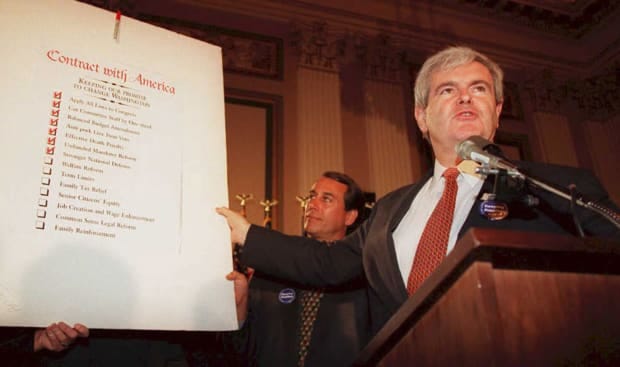
The ’94 Republican/Gingrich Revolution cemented the final success of the Southern Strategy to woo Conservative Southern Democrats to the Republican Party by appealing to latent (or not-so-latent) racism. These appeals were often delivered in euphemisms like “states’ rights” (to do what, exactly?) and stories of mythical Welfare Queens, isolated cases of fraud generalized onto the entire Black ethnic group.

[

Two aspects of Gingrich’s rise help elucidate the underlying cultural conditions that made possible the Republican party’s later decent into madness. The first is the curious fact that, despite Nixon’s successful use of the Southern Strategy in his presidential runs, it wasn’t until after the demise of America’s great existential threat, the USSR, that enough Southern whites switched parties to create the Solid South block that catapulted Gingrich to power. The other aspect is that Gingrich succeeded in explicitly tying American Christianity to one side of the partisan divide. This signaled a shift in focus for the American Conservative consciousness from the existential threat of Communism to domestic threats. Liberals were no longer just untrustworthy allies in the global fight against Bolshevism. They were now unGodly, the enemy, “evil”, thereby filling the role left by the falling atheist empire.

And so Gingrich enacted the Republican Revolution in ’94 by questioning the loyalty of his Democratic colleagues with rhetoric such as “people like me are what stand between us and Auschwitz. I see evil all around me every day.” He used conservative Christian tropes to reinforce his efforts to define political enemies as threats, often naming gays, atheists, communists, secularists, liberals, and Islamists interchangeably. In the absence of a credible foreign threat, all opponents of the Republican Party (a party increasingly defined as White, rural, heterosexual, and Christian) were fair game. From 1969 to 1994, the Republican Party had moved all the way from Nixon proposing a guaranteed minimum income to Gingrich describing any effort to provide health insurance to all citizens as “evil.” Of course Gingrich himself was hardly a paragon of conservative American virtue (he was also succeeded as Speaker by a man who later confessed to sexually abusing children). None of this dimmed Conservatives’ sense that the Grand Ole’ Party was the last beacon of moral probity in the world. This lack of concern with the moral failings of the movement’s leaders was partly explained away by (partially) fair comparisons with Bill Clinton, but it also foreshadowed the party’s total abandonment of principles when an unabashed chauvinist later presented himself as a savior.

The Conservative movement even made efforts, however ham-fisted, to directly transition the rhetorical label of the previous, legitimate existential threat onto internal political enemies. “Cultural Marxism” emerged as a Conservative bogey man through the writings of William Lind, Michael Minnicino, and crank pseudo-academics like Kevin MacDonald. The theory even tied in pre-Cold War spectres, claiming that Jewish academics of the Frankfurt School imported post-modernism to the West in a premeditated effort to undermine Western culture. This line carried forward the Nazi preoccupation with the corrupting influence of Jews into the Pax Americana context. The theory’s name even echoed Nazi claims of Jewish “Cultural Bolshevism.” (We can dispense with any semblance of sanity in these theories by noting that post-modernism is, at root, a rejection of grand historical narratives… grand historical narratives like Marxism).

Predictably, the apocalyptic rhetoric spilled out into real violence. In 1995, anti-government extremists detonated two and half tons of ammonium nitrate next to the Alfred Murrah federal government complex in Oklahoma City, killing 168 people and damaging hundreds of buildings. In 1996, Eric Rudolph set off a pipe bomb at the summer Olympics in Atlanta, motivated by the event’s promotion of “global socialism.” He would go on to bomb a gay bar and an abortion clinic before being apprehended in 2003. Abortion clinics were plagued by murders, assaults, kidnappings, and arson throughout this period.

The Conservative gaze shifted briefly after September 11th, 2001 when Osama Bin Laden graciously answered Conservatives’ call for an anti-Christ. The resulting War on Terror consumed the lives of thousands of American service members and $8 trillion of national treasure (funds previously unavailable for health care, infrastructure, education, and other basic functions of government in a Western industrialized society). While Republicans continued to tie political enemies to existential threats, they at least offered the possibility to be “with us or with the terrorists,” rather than naming domestic enemies as the existential threat themselves.

Despite the War on Terror’s enormous expense and embarrassing strategic failures, the perceived threat of massive, destructive international terrorism faded and was more or less forgotten after the death of Osama Bin Laden. The Bin Laden raid occurred the same night that Barrack Obama mercilessly roasted Donald Trump at the White House Correspondents Dinner. Trump rose to political prominence based on Birtherism, an Arendtian detachment of fact and fiction if there ever was one. His embarrassment and rage from the Correspondents Dinner fueled his determination to run for president. He later won the presidency on a campaign of violent rhetoric, press bashing, aid and comfort from the globe’s preeminent authoritarian leader (an actual former Communist and KGB member), and incoherent conspiracy theories that found purchase with an audience of cynical and alienated Fox News viewers. His relationship with his base echoed Arendt’s writings, which in their time were insightful, and now read as remarkably prescient as well:

In an ever-changing, incomprehensible world the masses had reached the point where they would, at the same time, believe everything and nothing, think that everything was possible and that nothing was true. … Mass propaganda discovered that its audience was ready at all times to believe the worst, no matter how absurd, and did not particularly object to being deceived because it held every statement to be a lie anyhow. The totalitarian mass leaders based their propaganda on the correct psychological assumption that, under such conditions, one could make people believe the most fantastic statements one day, and trust that if the next day they were given irrefutable proof of their falsehood, they would take refuge in cynicism; instead of deserting the leaders who had lied to them, they would protest that they had known all along that the statement was a lie and would admire the leaders for their superior tactical cleverness.

At first glance, American Conservatives’ insistence that their neighbors pose a threat to life, limb and liberty – while simultaneously denying that combustion engines could possibly be contributing to an actual global catastrophe – seems utterly bewildering. But we need only step back to see that their misplaced millenarianism is baked into Western, Christian, and especially American culture. From the Book of Revelations, to the Jonestown Massacre, to UFOs, to the ubiquity of the zombie genre, the end of the world thrums in the background of American life. Turn on PBS; an octogenarian relates seeing the first dust storm approach in 1930’s Oklahoma, and what does her mother yell to her? “Get in the house, the end of the world is coming!” Fantasy films whose sole purpose is (one would think) to distract us from the quotidian rhythms of our daily thoughts and lives, can’t help but zoom out in the final moments to reveal the Statue of Liberty corroded and listing from a long-passed catastrophe. From Dr. Strangelove, to preppers, to The Walking Dead, to preachers’ weekly pulpit invocations of a “Kingdom Come,” the assumption of an eventual world rupture is taken for granted. It is a culture-wide anxiety which, on an individual level, would be denied as silly and the ravings of “the crazies.” But look around with an objective eye and it is undeniable: we, as a people, are culturally primed for a world-ending cataclysm.

This sense of impending doom permeates Christianity, especially its charismatic and evangelical offshoots. During the early church’s rise in the shadow of a distrusting Roman Empire, martyrdom became the ultimate expression of connection with the Lord. To die a victim’s death, in the fashion of the son of God, came to embody the ultimate expression of devotion. And when the Christian sect came to dominate Roman politics, and therefore the levers of power, opponents of the Church (or often as not opponents within the church) were labeled as the heirs to the persecutors. Thus by the time of the crusades, those who took up the call to retake the holy land through violence would be bestowed in death with all the heavenly benefits of martyrdom. This view of the cosmically ordained righteousness of Christians and the demonic intentions of their foes pervades Western consciousness from Paul, to Constantine, to descriptions of the Vikings, to the Crusades, to conflicts with the Ottomans, to American explanations of the morality of slavery, right up to the modern American right’s belief in a heavenly mandate for their cause.

With this cultural priming, American whites have had to contend, first, with a genuine threat of obliteration from an ostensibly secular nuclear power. And now, the real threat passed, they are faced with a far more banal world-ending event. The march of demographics pre-ordains that Conservative whites will lose their voting majority in the future. This idea, framed in academic terms as a natural and neutral event, becomes in the hands of right-wing crack pots a premeditated ethnic cleansing: “replacement theory.” This seemingly inexorable movement towards voting minority (or more likely plurality) is paired with the depressing reality that their preferred policy prescriptions for isolating themselves from their Black neighbors has created a quality-of-life bottleneck that boomeranged back onto Conservative whites’ own children. Ubiquitous single-family zoning has limited the housing supply to the point that young people entering the job market are effectively priced out of housing in many areas. A current of anti-intellectualism coupled with a calculated defunding of schools at all levels post-Brown v. Board convinced many young whites, especially males, that college isn’t worth it, or else saddled them with crippling debt. This, combined with their now-unaffordable rent and the multi-thousand dollar depreciating asset they need just to get to work from the suburbs, compiles into one of the first falls in quality-of-life from one generation to the next in American history.

American Conservatives have painted themselves into a corner. Unlike European countries that adopted social policies to blunt the worst effects of capitalism, and thereby diffuse the left’s revolutionary zeal, American Conservatives cannot reconcile with policies that would accrue to Black people because they have spent decades building a political coalition based on the fundamental belief that hardworking-bluecollar-salt-of-the-earth-red-blooded-God-fearing-small-business-owners are solely deserving of social status in American culture. And so policies that might benefit these paragons of American virtue must be discarded out-of-hand if there is even a chance that the same benefit might accrue to the unworthy, the alien, the Welfare Queen. This leaves struggling white Americans up a creek – with a privileged position in the country’s cultural life that does not translate into the most basic promise of an improved quality-of-life for their children. These failures are internalized as the result of disdain from “Coastal Elites,” an impression which on a cultural level can certainly be accurate at times, but which on a political level requires the willful misinterpretation of liberal policy positions that would benefit Conservatives’ lauded rural working man as well.

And this is where the American Progressive movement has resoundingly failed. Ridiculing an opposing political coalition who is motivated by fear and perceived contempt is not only moronic politics, but more importantly evinces a misunderstanding of the phenomenon. Arendt, once again, lights the way,

The masses’ escape from reality is a verdict against the world in which they’re forced to live.

There are two ways to Trump voters’ hearts: the Social Security way, or the Cold War way. Either find a way to acknowledge their suffering, offer real solutions to their problems, and redirect their impulse for cultural dominance towards the creation of a shared identity with the nation as a whole; or find a credible, foreign, existential threat.

An exchange between one of the architects of the modern Christian political movement and a leader of America’s real existential threat illustrates the point:

President Ronald Reagan, “What would you do if the United States were suddenly attacked by someone from outer space? Would you help us?”

Gorbachev, “No doubt about it.”

Reagan said, “We too.”

Gorbachev, “So that’s interesting.”

Is Trump a Fascist?

If we’re going to call someone a fascist then we should come up with a working definition of fascism, and man alive is that harder than it sounds. I won’t bore you with the academic hand-wringing over defining fascism. Suffice it to say, there are many contradictions and ambiguities built into the term.

For our purposes, I condensed the general traits of fascism down to a consensus list of ten traits. In no particular order:

  1. Nationalism, and more broadly, viewing the world as a zero-sum competition between ethnically-defined nations.
  2. Idealization of a lost “golden age” of the nation’s past. Teutonic Age for the Nazis; Roman Empire for the Fascists in Italy; the Spanish Empire for Franco.
  3. Authoritarian, charismatic leader. And by “authoritarian,” let’s say we mean someone who thinks that the executive function of government should supersede the judicial and legislative functions.
  4. Violence as a legitimate means to achieve both domestic and international objectives.
  5. Militarism, often a military-style organizational structure that includes current and former military personnel, coupled with a nakedly expansionist foreign policy.
  6. State control of the media.
  7. Nationalization of industry, but without the class warfare rhetoric of communism, and often with the consent of the business community.
  8. Comes to power in the aftermath of a national trauma. Appeal to voters promotes narratives of slights to the dominant ethnicity by internal and external scapegoats.
  9. Ambiguous religiosity, but a great deal of overlap with Christianity’s conservative values and willingness to co-opt religion or create state-sanctioned religions if it suits the needs of the regime.
  10. Total disdain for human rights, democracy, labor rights, intellectuals, modern art and feminism.

My frame of reference here is Franco’s Spain, Mussolini’s Fascist Italy (capitalized because that was the actual name of the party), and of course Nazi Germany.

It’s worth considering for a moment that most dictatorships have a passing resemblance to fascist regimes. This is because of the simple mechanics of running an authoritarian regime. For example, most dictatorships are at least internally militaristic for the simple reason that they cannot survive without the support – if not the direct control – of the military.

So, how does Donald Trump line up? Let’s walk through these.

1. Nationalism – check

“America First.” It’s worth noting that this phrase was first prominently used by the anti-war coalition in the run up to WWII. This group was sympathetic to Nazi Germany’s policies and was blatantly anti-Semitic. I’m willing to give Donald Trump the benefit of the doubt that he wasn’t aware of this connection the first time he used it. I’m not feeling so charitable about him using this line in his inaugural address after that connection had been widely reported in the media.

2. Idealization of the Nation’s Past – check

“Make America Great Again.”

3. Charismatic/Authoritarian Leader – check

Donald Trump has shown little understanding of the separation of powers enshrined in the constitution and has attempted to delegitimize (a) every court ruling against his interests, personal, governmental, or otherwise (b) any expression of political will contrary to his interests (c) any effort by Congress to rein him in.

4. Violence – check

Donald Trump largely condoned (or refused to denounce – take your pick) violence towards protesters at his political rallies during the campaign. He often speaks in very violent language. Phrases like “American carnage” give his supporters the impression that the are victims of violence and should respond in kind. This is very similar language to both Mussolini and Hitler. Franco didn’t need to hint at this because he came to power in the midst of a real war.

5. Militarism – meh

I’m going to give Donald Trump a pass on this one. While he has expressed a desire to use military power to take other countries’ natural resources – “we should have taken the oil” – his general tone is more isolationist than expansionist. He does not come from a military background and does not exhibit the obsession with military hierarchy and uniforms that was a hallmark of European fascism, despite his attendance at military school.

6. State Media Control – check

Trump’s constant berating of “the media” covers both scapegoating and a sense that we would all be better off if “the media” would just cover his side of the story. I have no doubt that he would crack down hard on the press if it weren’t for America’s vigorous 1st amendment protections.

7. Nationalization of Industry – meh

While the Nazis shared The Donald’s chummy ties with the country’s banking and industry moguls, I don’t think it’s fair to compare Trump’s laissez faire economic policies with fascists’ aggressive, centrally-controlled economic vision.

8. National Trauma/Scapegoatism – check

“National carnage” – “bad hombres” – “they’re rapists” – “stealing our jobs” – The Donald’s world view is a dystopian hellscape with fifth column liberals traitorously betraying “real” Americans to the hordes at the gates. It is remarkable how slight a trauma tipped us into this kind of language considering the difference in scope between the Financial Crisis and the combined effects of WWI and the Great Depression.

9. Ambiguous Religiosity – check

Trump has no idea what 2 Corinthians is, but thinks Christians should have priority over Muslims in immigration policy. He has also made comments about returning to the days of automatic church attendance. This despite his rather hedonistic past and repeated divorces. He is not a Christian, but he understands and values rote religious practice.

10. Disdain for Human Rights, Intellectuals, estc – check

I’m not going to list all the horrible things he’s said for the sake of making this argument. It’s clear that the only human rights Trump cares about are the rights of white, Republican-voting Americans.

So, Trump’s fascism score is an 8 out of 10.

To be fair, the military organizational structure and nationalized industry are defining features of fascism. By those measures Trump doesn’t line up. If you call Trump a fascist, then Italy’s Berlusconi was a fascist, and that doesn’t quite pass the smell test.

Of course, that doesn’t mean we shouldn’t be worried. Defining a movement as fascist is to some extent academic. There are plenty of evils in the world besides fascism. I’m sure the poor souls toiling in the killing fields of the Khmer Rouge took little solace from the fact that they were not living under a fascist regime.

And it’s worth considering that each of the big three European fascist rulers had their own paradoxes and contradictions that make it difficult to fit them neatly into a fascist box. The story gets even more confusing if you include fascist movements from occupied countries like France and eastern European fascist movements like Romania’s Iron Guard.

Each leader subsequent to Mussolini picked the elements that fit his particular political situation, and Mussolini was in turn re-influenced by Nazi Germany. Franco, in particular, probably wasn’t personally a fascist, but he was perfectly willing to use the framework of fascism to kill thousands of people and implement a regime that lasted until his death in the 70’s.

So, perhaps we’re asking the wrong question. Though less catchy, the better question is “what are Trump’s goals and how do those goals differ from American values?” This is really a question we should ask of all our leaders and, to that end, the fascist comparison is a good one, because it forces us to consider the underlying policies and goals of this political creature, Trump, that is so difficult to pin down on anything.

If we think about fascism in the context of its history and as an iterative, malleable ideology, then it matters less that Trump check off every single on the fascist check list. In this view, we land on a terrifying prospect:

Mussolini comes to power in Italy 1922 – Fascism 1.0

Hitler comes to power 1934 – fascism 1.1

Franco takes command of nationalist forces in Spain 1936 – fascism 1.2

Hitler invades Poland 1939 – fascism 2.0

Mussolini declares war on Britain 1940 – Fascism 2.1

Franco adjusts his political stance to shed de jure fascism 1948 – fascism 3.0

Trump comes to power 2016 – fascism 4.0?